Translate into another language

Wednesday, October 17, 2012

Pho


We learned our very first day that pho, a wonderful soup of broth with rice noodles and vegetables (chicken or beef optional, as well as peppers and a host of other condiments*) is the meal of choice for the Vietnamese. It can be eaten at any time of day; many people pause at their favorite neighborhood pho restaurant on the way to work, to begin their day with a bowl.

Pho (pronounced "fur" but without the "r") became a sort of comfort food for us too, a delicious and dependable staple. It is really, really good.

*The condiments lined up at breakfast yesterday (yes, we are at a nice hotel) were: carmelized anchovies, salted eggs,salted white radish, fried onion, fish sauce, soya bean sauce, fresh lemon (lime), fresh chili, chili sauce, salt and pepper, ginger, spring onion...and ketchup.

Honda Heaven?

Motorbikes are clearly the main mode of transportation for the Vietnamese people today; very few cars and relatively few trucks and buses dot the roadways. It seems that South Vietnam saw the arrival of Honda motorcycles in 1967 with the 50cc Cub, and by 1972 there were hundreds of thousands on the road. Most of them were Hondas and the brand name became the generic term for motorcycle.

In 1975, after the war, Hondas began arriving in the north and with the economy opening up in 1986, Honda saw an opportunity, introducing the Honda Dream. It cost a relative fortune at $2,600, and whole families commonly traveled on one bike.

In the mid-90s, the Hondo Dream #2 and #3, with 110cc, hit the market. Eventually the Super Dream arrived and prices were now about an average two month's salary at $1,100 and soon about 27-29 million motorbikes existed in Vietnam. The law sets maximum passengers at two adults and two children but it is not enforced (enforceable?).

Huy points out that not only is the bike an economical way to move, it "works" in a society where roads are relatively small, the population dense, and, perhaps most interesting, it is easy to pull up to the ubiquitous house-front shops that supply daily necessities. Everything is moved by motorbike -- huge piles of products, boxes, fresh eggs, a water buffalo (legs tied to avoid kicking), and Huy's new refrigerator!


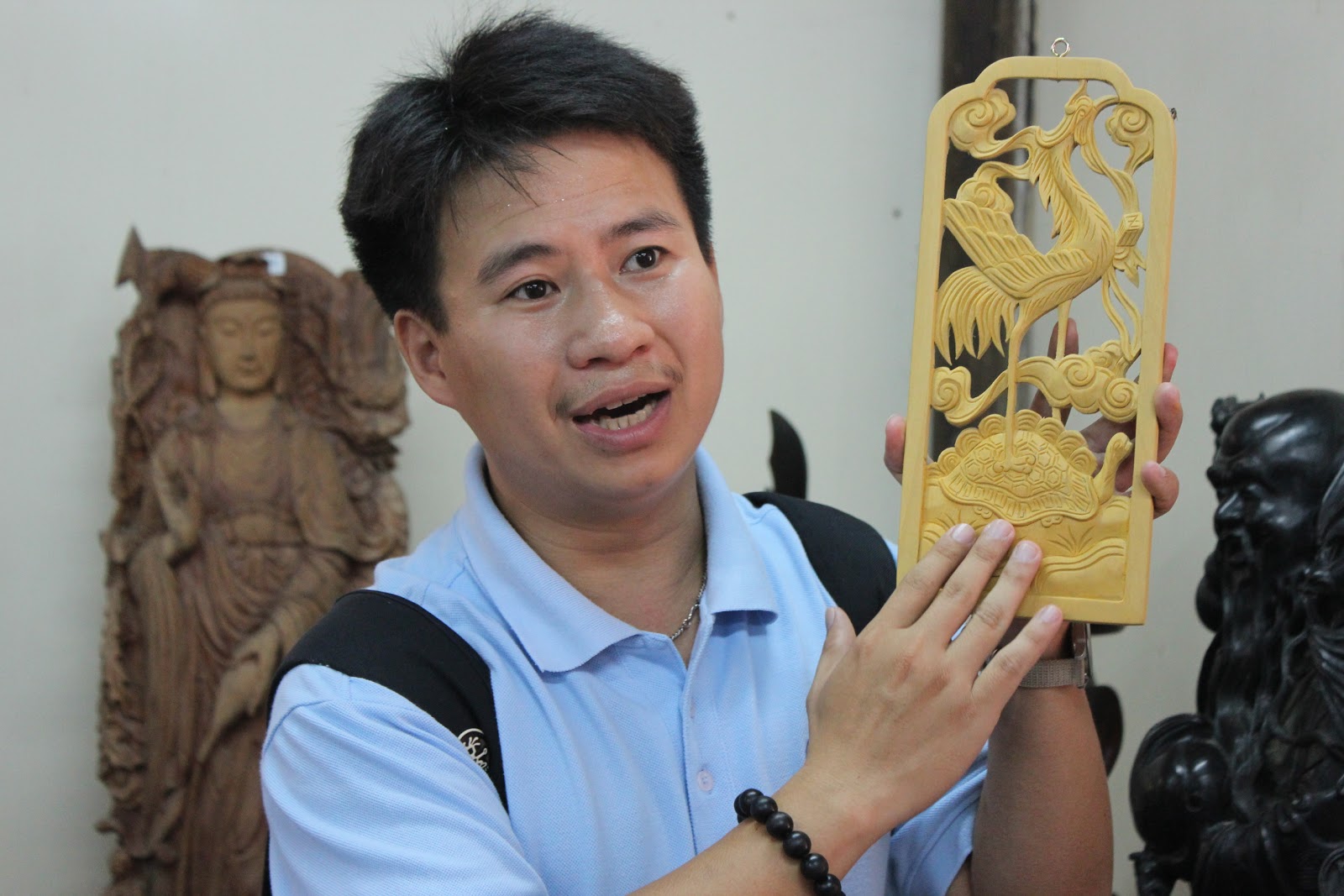
The Crane and the Turtle

A Vietnamese proverb says:

"The crane and the turtle are friends."

Huy tells us the story of the crane and the turtle.


Bronze crane and turtlein the Temple of Literature


"Once there was a great flood. All the land was covered with water. The crane flew and flew, looking for a place to land. He didn't find any dry place on which to land. Finally, a turtle rose above the water's surface and said, "You can rest here on my shell." So the crane rested.

"Later on, all the water in the turtle's lake dried up. The turtle became very dry. It needed to be in the water. The crane swooped down, picked up the turtle, and carried it to a lake where there was water.

"So, you see, the crane and the turtle cooperated to help each other.
Gilt crane and turtle in restaurant

Gilt crane and turtle on wall of restaurant


"When you see the image of the crane on the turtle's shell, you cannot say that the crane is standing on the turtle. The image is to remind us that we need to cooperate and help each other."

Vietnamization

Throughout our journey Huy has repeatedly mentioned how the Vietnamese have kept parts of cultures which have conquered them over time and have made the part uniquely Vietnamese. Examples of Vietnamization:

From the Chinese: The signs of the zodiac have been Vietnamized. Where the Chinese have the year of the ox, for the Vietnamese it is the water buffalo. Where the Chinese have the year of the rat, for the Vietnamese it is the cat.

Confucianism: Confucianism reached Viet Nam over 2,000 years ago. The Vietnamese imperial dynasties adopted Confucianism pragmatically because of its ability to sustain a system of social order without much repression, and for its code of social mobility based on merit. The Vietnamese people think of Confucius not as a god, but as a founder of a philosophy. Huy commented: "The knowledge you gain from education defines what you can contribute to society."

From the French: "We threw out the French, but kept the bakery...(pause) so you can have a choice at breakfast." e.g. croissants, brioches, patisseries.

At the daycare center in the small village near Hoi An, the 3- and 4-year-olds broke into a melody which we recognized as Frere Jacques; the lyrics were Vietnamese.

Water hyacinths were imported by the French because they liked the lavendar blossoms. The plants are invasive in Vietnam. We have seen the plants near rice fields and floating on the Mekong River. The Vietnamese are finding ways to use the troublesome plants: as food for pigs, as fertilizer, as strong paper for paper bags, for furniture,clothing, and hand bags. Yes, the Vietnamese are creative and enterprising.


Floating market on the Mekong


Rusty has already posted an image of this morning's trip down the river to this remarkable floating market.  This is a wholesale operation, where families bring boatloads of produce, identified by the item placed atop a tall bamboo pole, to sell to retailers who transport it to further markets.


We slowly wove our way through hundreds of boats, grouped according to produce:  cabbages, squash, sweet potatoes, bananas, pineapples, jack fruit, other root crops and fruits I didn't recognize.  Boats were full of life -- chickens, dogs, babies, colorful clothing, stoves and pots, clearly a floating home as well as wholesale storefront. The amount and variety of produce was impressive!


While this may seem quaintly rural, note the fellow above on his cell-phone... trading? while the young man in the smaller boat (with a very modern engine) is loading cabbages.


And of course, the enterprising vendors of soft drinks, water, and fresh pineapple quickly sideled up to the tourist boats to ply their trade ... "One dollah!"


Tuesday, October 16, 2012

Floating Market in Can Tho

We just embarked on a river boat early this morning headed for one of the many floating markets in the Mekong Delta region. More later!

Naivete in the Face of Ingenuity

From the Saigon airport to the Mekong Delta area we had a 3-hour bus ride. Huy's first words on the bus were: "Do you want to hear another passport story?"

Huy began by explaining that in 1995 Vietnamese could travel freely within the 10-nation ASEAN nations. No passport required. Most Vietnamese travelers were inexperienced. Many Ha Noi residents had not traveled beyond Ha Noi.

"One day a tourist company called me and asked if I wanted to handle a big job. I said yes.The job would be taking a group of travelers to Russia. There would be 54 in the group...a large group. I was told, 'Whatever the cost you must hold the passports for everyone.' I said I could do that. I had an extra large bag.

"The flight went from Ha Noi to Bangkok, to Dubai, and to Moscow.When we arrived at a huge hotel in Moscow, I told the group to meet at breakfast at 9:00 in the morning. I was exhausted and went straight to bed.

"In the morning, in the dining room, I thought something was strange. I did not see one of my group at the dining room. The local guide arrived at 8:50 am as arranged. Still not one of my group was anywhere to be seen.

" I called every room. No one answered the room phone. At 9:10 am I got a master key and a hotel employee and I went to the rooms. No one was in any of the rooms.

"I decided I needed to call the office in Vietnam. I explained what I had done and that none of the travelers were in any of the rooms. The office said, 'We know that. Don't worry. They had no intention of seeing Russia at all. And, do you have all the passports?' "Yes," I replied. "I do have all the passports."

Well, the explanation for the "disappearance" of the group is that in early 1990, Vietnamese monopolized the whole black market in Russia. Then, they needed laborers to help with their businesses. They wanted to bring some friends and maybe some relatives to Moscow. So the shortest route was to bring them via a travel agency.

"Having lost the group, I upgraded my room to a suite, then had a nice private tour of the places where I would have taken the group.Then I returned to Vietnam. What should I do with the 54 passports? The agency said the police will come to ask you some questions.

"The police did come. They said they heard that I had lost everyone in the group. "Yep,I did. I lost all of them." Well, this turned out  to be nothing bad at all. The travelers had paid the equivalent of $600 USD per person to the government.So the government was happy. This was a legal human trafficking system.

"Many years later,I met one of those people in Ha Noi. I asked how things were going for him. Very well, it turns out. Most of those people were able to earn $400 to $500 USD per month and send half home to Viet Nam. His wife could build a big house and send their children to the university. There were a few hundred thousand Vietnamese people living in Russia.

"So I asked What if you want to go back to Viet Nam? Well, that's not a problem. You get a big group of friends. You go to a bar and create a scene. You get arrested and kept in jail for about a month. Then you are put on a plane and are sent back to Viet Nam."