Yesterday (Thurs 10/18), after a fascinating day along the upper Mekong stopping by an island nursery of young saplings (mango, coconut, plums, jackfruit, etc) and a brick factory (more in another post), we had the long bus ride back to Saigon. En route, Huy spoke to us at length about that dark period of post-reunification in Viet Nam between 1975 and 1986.
Born in 1976, Huy's memories are that of a young child, but he remembers the long lines for food, and the morning he went to the place where he heard there would be fish (a rare treat) only to finally get a piece as big as two fingers in a huge block of ice, hardly enough to feed a meal to this family of five. They were allocated one chicken a month; to get a second by way of the black market was to risk jail if a neighbor exposed you. His parents worked for the government in Hanoi, but still had to engage (with "negotiable skills") in the black market, saving what money they could to purchase gold ( the only secure investment).
The government controlled everything. There was no such thing as private enterprise. All farming was communal. Regardless of how good your skills at farming, all proceeds went to the government and were reallocated in a way the government thought would ensure equality. If the commune met or exceeded production goals, it would be credited to good communist leadership. Coming in below expectations was blamed in the weather. Because there was no incentive for individual initiative, all motivation to excel was killed, said Huy. The economy began to flounder.
Huy then shared the following story: Three prisoners were talking. One said he was in jail because he arrived at the factory too early and was accused of being a spy. The second said he was arrested because he arrived too late and was accused of not supporting the communal system. The third arrived on time; he was accused of purchasing a foreign watch.
(Always using humor to lighten a difficult subject.)
Viet Nam was like an island, said Huy. One needed permission to visit atmosphere town. The only foreigners were Soviets, and people were told not to speak with them. There was only one radio station, and the television broadcast just two hours a night, primarily Soviet content.
Liberal members inside the communist party realized although the country was united, things were getting worse. Some said, we are running the country the wrong way. So following an election when more liberal members were elected to the party, they decided to open up Viet Nam to the outside world. They allowed private enterprise. Factories were privatized. They redistributed the communal agricultural land among families, according to how many workers there were in each family. In only two years, from 1986 to 1988, Viet Nam went from importing rice aid from India to again exporting rice. Now Viet Nam is the second largest rice exporter in the world.
In 1995, the US lifted its embargo of Viet Nam. The economic gains made in just 25 years are astonishing. The television in our hotel room carries CNN, BBC, HBO, ESPN, National Geographic, CNBC, Australia network, Cinemax, Discovery, and another 45 channels... For better or worse!
And although the Internet is somewhat controlled by the state (Facebook is blocked, for example), there are always ways to get around it, according to Huy.

We are cousins who graduated from Smith College in the 1960s, in the midst of the Vietnam War. We live in different parts of Massachusetts now and are delighted to be traveling together to Vietnam. Our understanding of Vietnam's history and culture has grown by leaps and bounds as we prepared for our trip through reading. We hope family and friends will join us, virtually, as we take our trip!
Friday, October 19, 2012

Money
The three stooges. That's what we feel like trying to calculate dong into dollars, or dollars to dong. Or, despite the difference in color and size, making sure what we pull out is 50,000 not 500,000 dong. Something about all those zeros! By the time you get five or six zeros after the primary number, they all sort of blend. Five,is it? This might work.
Yesterday, the three of us went to a local bank. Well, sort of local. Australia New Zealand Bank. But all things are relative here. And these relatives were definitely "negotiable!" We couldn't change money at the bank because we didn't have an account there, so went to the ATM. I made it through all the various steps to cash 4 million (!!! Yes, we are all millionaires in Viet Nam.) until I saw the fee would be 40,000. I immediately cancelled the transaction, thinking they were charging a usurious 10%! Ah, decimal points.
Then there are the "dinner on your own" negotiations around the bill. How much to tip? What is the actual cost of a beer? You mean, Perrier is twice the price of beer? And making change? Forget it!
We'll probably get it down about the time we have to start thinking in dollars again. $50,000? Why, that's a bargain!
Awesome Archeology


Books Recommended to Us
We received several titles for recommended reading before our trip to Vietnam. I thought I'd mention them here in case any blog readers are inspired to read beyond our blog (!) or in case any readers want to make further suggestions in a comment.
I was riveted by Duong Van Mai Elliot's The Sacred Willow: Four Generations of a Vietnamese Family published in 2000. The book description provided by the publisher (shown below) is excellent. For me, hearing the story of families separated by choices and geography and accounts of the manifest spirit and drive for independence of Vietnamese people against the pressures of politics, war and its aftermath provided a textured introduction to underlying elements of our journey. My understanding could not have been the same without this book.
David Lamb's Vietnam Now provided a great foundation for rethinking my understanding of Vietnam from my early exposure during the American war. Lamb was here during the war and then returned twenty years later. His journalist's eye brought both the changes and the enduring themes in Vietnam's culture alive and placed the country on a contemporary trajectory I could begin to comprehend.
I have only read the first chapter of Neil Jamieson's Understanding Vietnam but hope to complete it. He establishes Confucian yin and yang as the metaphor for competing/complementary forces in Vietnamese society (an example might be cybernetic and organic growth) and I want to know how it plays out.
Book description taken from Amazon: "Duong Van Mai Elliott's The Sacred Willow, an extraordinary narrative woven from the lives of four generations of her family, illuminates fascinating--and until now unexplored--strands of Vietnamese history.
Beginning with her great-grandfather, who rose from rural poverty to become an influential mandarin, and continuing to the present, Mai Elliott traces her family's journey through an era of tumultuous change. She tells us of childhood hours in her grandmother's silk shop--and of hiding while French troops torched her village, watching blossoms torn by fire from the trees flutter "like hundreds of butterflies" overhead. She reveals the agonizing choices that split Vietnamese families: her eldest sister left her staunchly anti-communist home to join the Viet Minh, and spent months sleeping with her infant son in jungle camps, fearing air raids by day and tigers by night. And she follows several family members through the last, desperate hours of the fall of Saigon--including one nephew who tried to escape by grabbing the skid of a departing American helicopter.
Based on family papers, dozens of interviews, and a wealth of other research, this is not only a memorable family saga, but a record of how the Vietnamese themselves have experienced their times. At times haunting, at times heartbreaking--it is always mesmerizing."
PS: Another book recommended by fellow traveler Debra is Paradise of the Blind by Thu Huong Duong, writing of three women during the hardships in the slums of Hanoi during the tumultuous time of land reform.
Thursday, October 18, 2012
It's All About Boats
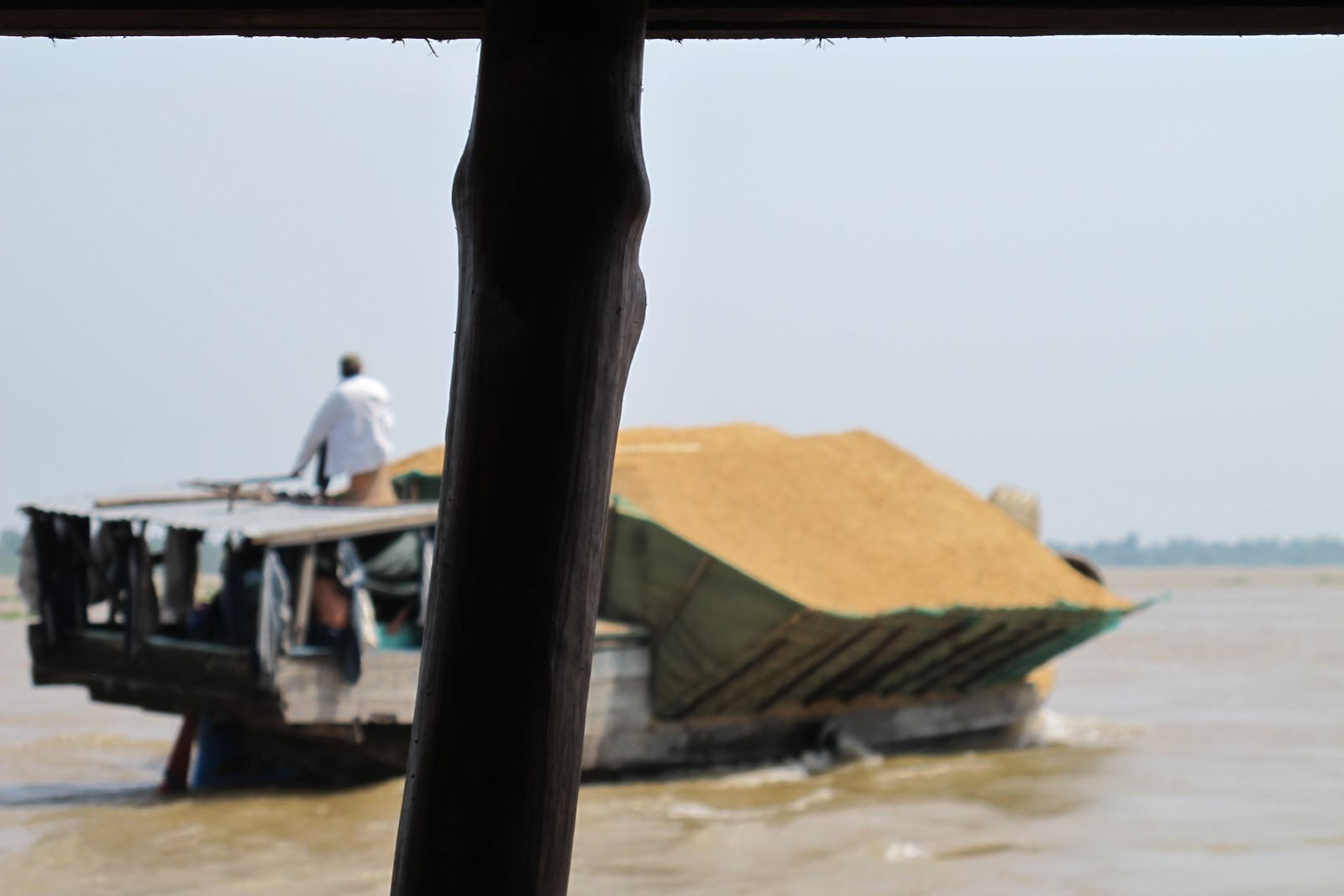
On all Vietnam's waterways, perhaps particularly in the Mekong Delta region, boats are the name of the game. They are floating gasoline stations, they carry products from business site to business site (huge barges of rice or gravel or wood), they taxi people to and fro, they carry tourists up and downriver as they learn about Vietnam, they are traveling 7-elevens with soda pop aboard, they provide homes as farmers travel, they transport goods to market. I hope to add more pictures to give you a better idea of the flow of boat traffic on the river! Smaller boats are powered by nifty "long-tail" motors providing the ability to navigate adriotly in small spaces. (picture coming)...



Wednesday, October 17, 2012
Pho

We learned our very first day that pho, a wonderful soup of broth with rice noodles and vegetables (chicken or beef optional, as well as peppers and a host of other condiments*) is the meal of choice for the Vietnamese. It can be eaten at any time of day; many people pause at their favorite neighborhood pho restaurant on the way to work, to begin their day with a bowl.
Pho (pronounced "fur" but without the "r") became a sort of comfort food for us too, a delicious and dependable staple. It is really, really good.
*The condiments lined up at breakfast yesterday (yes, we are at a nice hotel) were: carmelized anchovies, salted eggs,salted white radish, fried onion, fish sauce, soya bean sauce, fresh lemon (lime), fresh chili, chili sauce, salt and pepper, ginger, spring onion...and ketchup.
Honda Heaven?
Motorbikes are clearly the main mode of transportation for the Vietnamese people today; very few cars and relatively few trucks and buses dot the roadways. It seems that South Vietnam saw the arrival of Honda motorcycles in 1967 with the 50cc Cub, and by 1972 there were hundreds of thousands on the road. Most of them were Hondas and the brand name became the generic term for motorcycle.
In 1975, after the war, Hondas began arriving in the north and with the economy opening up in 1986, Honda saw an opportunity, introducing the Honda Dream. It cost a relative fortune at $2,600, and whole families commonly traveled on one bike.
In the mid-90s, the Hondo Dream #2 and #3, with 110cc, hit the market. Eventually the Super Dream arrived and prices were now about an average two month's salary at $1,100 and soon about 27-29 million motorbikes existed in Vietnam. The law sets maximum passengers at two adults and two children but it is not enforced (enforceable?).
Huy points out that not only is the bike an economical way to move, it "works" in a society where roads are relatively small, the population dense, and, perhaps most interesting, it is easy to pull up to the ubiquitous house-front shops that supply daily necessities. Everything is moved by motorbike -- huge piles of products, boxes, fresh eggs, a water buffalo (legs tied to avoid kicking), and Huy's new refrigerator!


Subscribe to:
Posts (Atom)